
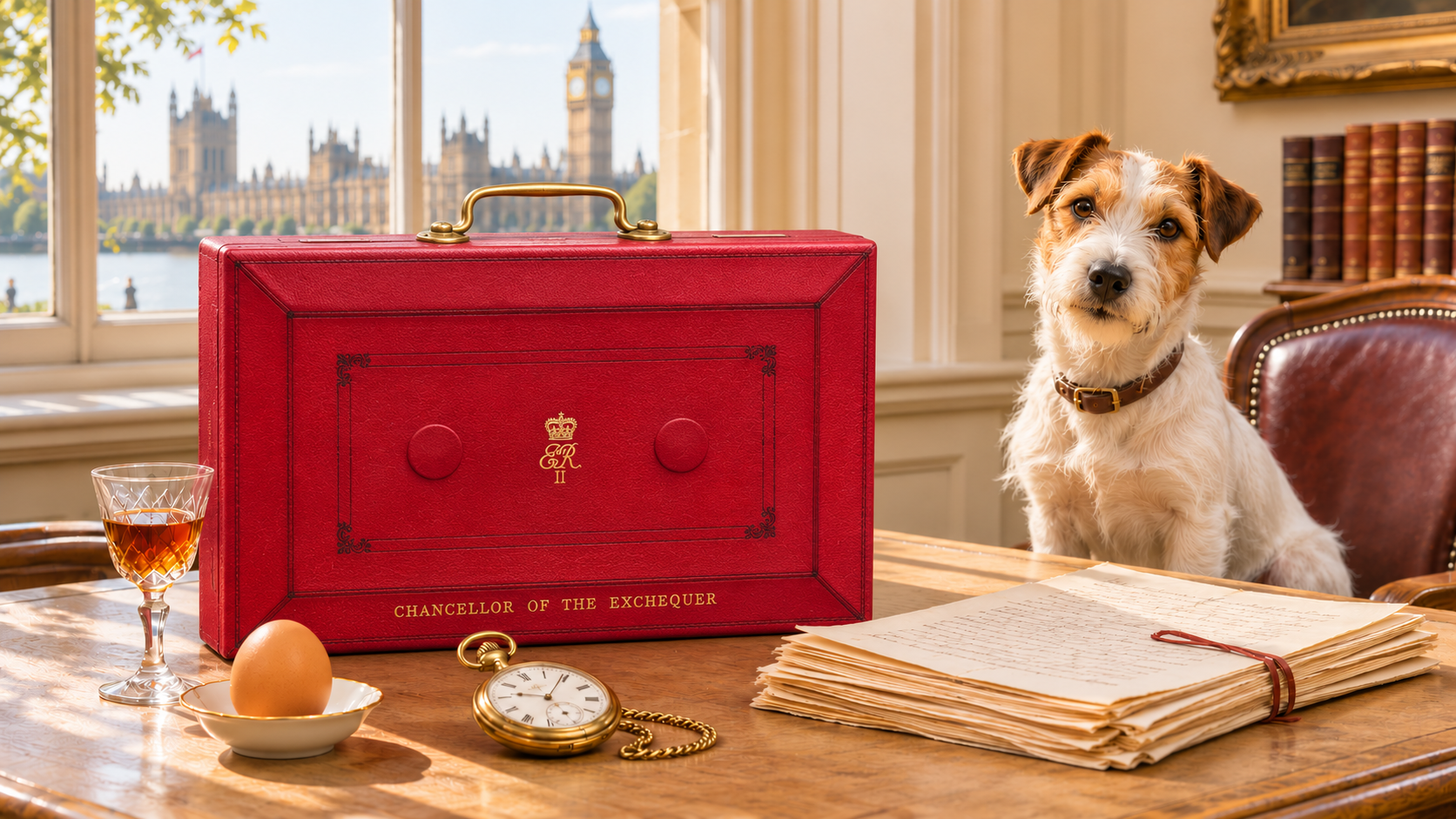
The Budget is usually judged by what happens to taxes, borrowing and the money left in people’s pockets. Its history, however, contains a supporting cast that includes an exceptionally durable box, a restorative mixture of sherry and egg, and a dog named after the event itself.
Behind the familiar photograph outside Number 11 lies a collection of traditions accumulated over centuries. Some explain how the Budget acquired its name; others reveal how much endurance was once expected of the people delivering it, and those obliged to listen.
Before it was a forecast, it was a bag
“Budget” derives from the old French word bougette, meaning a little bag. Financial statements were carried to Parliament in a leather bag, giving the contents a name inherited from their container.
The red box is its more recognisable descendant. According to Parliament’s account, the famous Gladstone box was made around 1860, constructed from wood, lined with black satin and covered in scarlet leather. Its working life would outlast successive governments and several generations of taxpayers.
Ministerial despatch boxes have a more dramatic security story: their lead lining was reportedly intended to ensure confidential papers sank if thrown overboard to prevent capture.
Not every chancellor used Gladstone’s box. James Callaghan introduced a replacement in 1965, while Gordon Brown marked his first Budget in 1997 with a new box made by four apprentices from his Dunfermline constituency. They joined him for the photograph outside Number 11, briefly sharing a stage normally reserved for Treasury ministers.
George Osborne used the Gladstone box for his first Budget in 2010 before switching to a new one in 2011. By then, the old container had earned its retirement more convincingly than most pieces of office equipment.
A speech measured in hours, not headlines
Anyone who finds a modern Budget speech lengthy can take comfort from William Gladstone’s performance on 18 April 1853. Parliament records it as the longest continuous Budget speech, lasting four hours and 45 minutes.
Benjamin Disraeli’s 1867 statement took 45 minutes, demonstrating that a Budget could be delivered in approximately the time Gladstone might have considered a substantial introduction.
Length also helps explain the interest in refreshments. Gladstone became associated with “egg-flip”, a mixture of sherry and egg used to sustain him during prolonged speeches. Historical accounts describe the bottle being carefully positioned within reach, allowing him to refresh himself before continuing.
The Chancellor’s traditional permission to drink alcohol during the Budget speech is a parliamentary exception, rather than a special legal entitlement. Accounts of favoured drinks have become part of Budget folklore, although the distinction between a well-documented habit and an enthusiastically repeated anecdote deserves care.
Gladstone’s mixture is sufficiently memorable without requiring anyone to revive it at the next financial presentation.
The temporary tax that really did disappear
Income tax is often described as a temporary measure that never went away. The actual history gives that familiar line an inconvenient interruption.
William Pitt introduced income tax in 1799 to help finance the war against France. After the Napoleonic Wars, opposition grew among landowners, merchants, manufacturers and other taxpayers. Almost 400 petitions against the tax reached the Commons, and in March 1816 the government lost the argument and abandoned it.
Income tax remained abolished until Peel reintroduced it in 1842. Its return came in different circumstances: the levy helped him remove import and export duties on more than 700 items.
This was again intended as a temporary arrangement, but growing government commitments, including the Crimean War, made abolition increasingly difficult. Income tax has remained since 1842, giving the joke about temporary taxation a sounder starting date, if a less convenient punchline.
When a conversation became the story
The tradition of Budget secrecy has produced consequences rather more serious than an unfortunate photograph.
In 1947, Chancellor Hugh Dalton disclosed details of his proposals during a conversation with a journalist from the Star. The information reached an evening newspaper while his Budget speech was still under way, and Dalton subsequently resigned.
The episode illustrates why the timing of financial announcements has long mattered. A speech intended to explain the government’s plans instead became overshadowed by the disclosure of its contents before Parliament had heard them.
Taking Budget for a walk
Geoffrey Howe contributed a more companionable detail to Treasury history by naming his dog Budget. Photographs show the Jack Russell with Howe and his wife, Elspeth, while accounts recall walks through St James’s Park on Budget mornings.
Naming a pet after the most demanding event in the departmental calendar might seem an unusual way to switch off from work. It nevertheless secured the dog a place in accounts of British fiscal history, an achievement unavailable to most household pets.
From a little leather bag to a long-serving red box, the Budget’s traditions have proved remarkably durable. The taxes and forecasts change, but the ceremony remains recognisable, carrying a little history alongside the financial decisions.